
Stand up for merit-based research funding
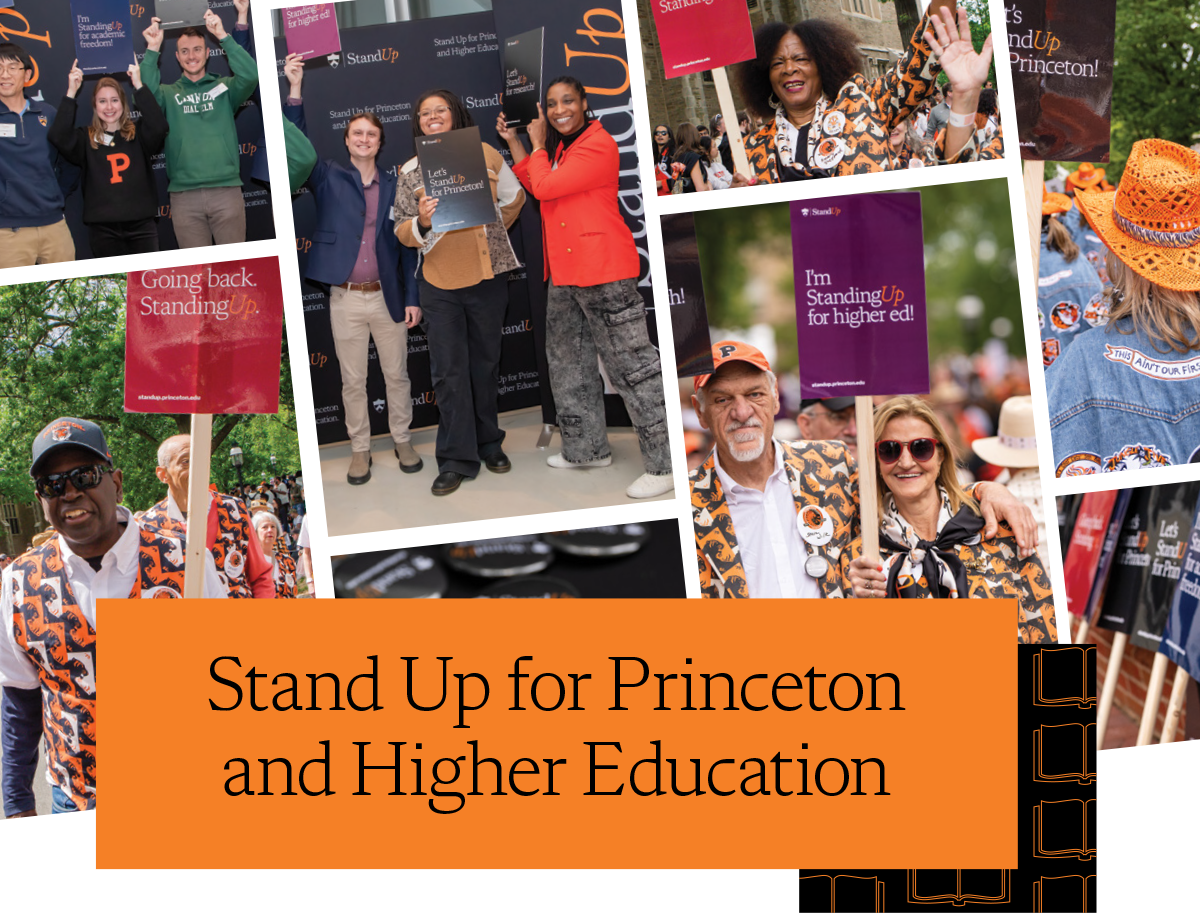
Whether you joined us for a photo in front of the Stand Up backdrop, carried a Stand Up sign in the P-rade, or shared what higher education has meant to you, thank you for making the case for Princeton and higher education during Reunions and Commencement. It is encouraging to see how our community of advocates has grown over the last year. Your voices move our mission forward and demonstrate our strength and unity!
As we talked about Stand Up with a wide range of Princetonians in recent weeks, one issue kept rising to the top: the importance of standing up for research. So in this newsletter, we put a special focus on funding from the National Science Foundation that has enabled Princeton to make discoveries in a broad range of disciplines, from cancer biology to quantum science. Today, this long-standing partnership between the federal government and research universities is at risk, with proposed rule changes that could broadly impact how the government funds vital scientific research going forward.
Join us in standing up for merit-based research funding that fuels invention, innovation and discovery to advance human health, strengthen national security and give America a crucial edge in global competitiveness.
Standing up for merit-based research

The U.S. Office of Management and Budget (OMB) recently proposed a rule that would implement major changes to the “Uniform Guidance” governing the administration of federal funding, including research grants. The proposed changes would codify a number of executive orders and affect nearly every stage of the award process at all federal research agencies. Here are five ways OMB’s proposal could upend U.S. science, from the Association of American Universities.
Princeton will be submitting an official institutional comment on the substantial impact these changes could have on our research and academic mission, in addition to supporting the efforts of academic associations and coalitions.
If you are interested in making comments to the federal government on the proposed changes, here are some suggested guidelines and resources available to you:
- Please be advised that your comments will become part of the public record and should be made in an individual capacity and not on behalf of the University.
- Comments are most effective when they speak directly to the proposed rule changes and include personalized content from those directly impacted by the rules.
- Additional commenting guidance can be found here.
- The deadline for submitting comments is July 13, 2026.
- More information about the proposed rule changes:
Highlights of NSF-funded research at Princeton

Discovering insights for the treatment of diseases
Cliff Brangwynne’s NSF-funded research as a CAREER Award recipient early in his career has changed how scientists understand structures inside cells, leading to foundational insights about cell functions and suggesting new ways to treat diseases such as cancer, Alzheimer’s and ALS. Brangwynne, a pioneer of cell biology, has demonstrated that many structures within cells are like raindrops, where molecules condense from their surroundings and band together. These structures have been shown to drive many basic cellular functions, including protein aggregation, gene expression, the immune response to viruses, cell growth and cancer, and more. NSF funding has provided long-term support for his research group through the Princeton Materials Research Science and Engineering Center. NSF funding for a graduate research network in the physics of living systems supports the continued vitality of the discipline.

Advancing photonics for everyday applications
With funding from an NSF Engines Development Award, Princeton leads Advancing Photonics Technologies. This regional consortium of over 100 partners across New Jersey, Delaware and southeastern Pennsylvania is driving economic and technological advancements in photonics, which involves the control of light for use in technologies. Photonics has applications in critical national priorities including health care, clean energy, computing, telecommunications, advanced manufacturing and more, with the potential to improve cancer detection, food safety, smart phones, computing and self-driving cars, among other uses. Princeton’s Office of Innovation is now a finalist for an NSF Regional Innovation Engines award to drive use-inspired research, tech translation and workforce development in the Mid-Atlantic, led by Princeton, Rowan and Rutgers universities and Nokia Bell Labs.

Accelerating research to the marketplace
Princeton is the lead institution for the NSF-funded I-Corps Northeast Hub, which enables researchers to form startup companies that translate laboratory discoveries into breakthrough products and services that benefit society. A recent success story is PolyGone Systems, launched by graduate alums Yidian Liu *21 and Nathaniel Banks *21 to remove harmful microplastics from waterways. Their advanced filtration system captures tons of invisible microplastics from wastewater before they are released into the ocean. In 2024 they launched the world’s first industrial-scale microplastics removal pilot at the Atlantic County Utilities Authority wastewater treatment facility, where their technology filters 40 million gallons of water per day and captures more than 580 million microplastic particles per year. They are now building three full-scale commercial systems in New Jersey and California.

Unraveling the mysteries of the universe
From its home atop a remote desert mountaintop in Chile, the NSF-DOE Vera C. Rubin Observatory explores cosmic mysteries, including the dark matter and dark energy that permeate the universe. With data management from Princeton researchers, the revolutionary system aims to capture the entire visible southern sky with unparalleled completeness, detail and speed, enabling every change to be precisely recorded, measured, catalogued and analyzed. The observatory enables scientists to observe exploding stars before they fade away, identify millions of asteroids and comets never seen before and unlock new mysteries in areas of astronomy and astrophysics.
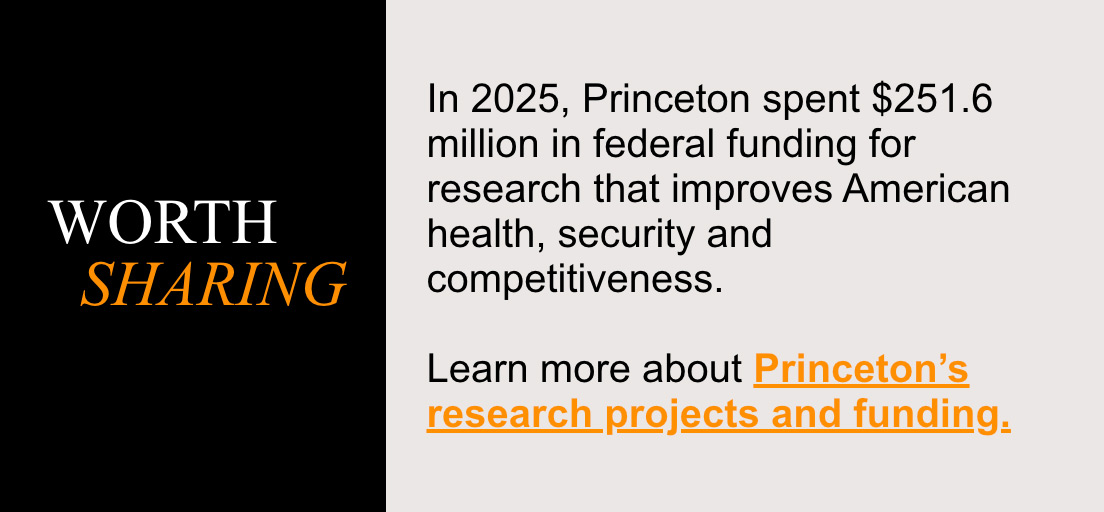
Support Princeton faculty and research
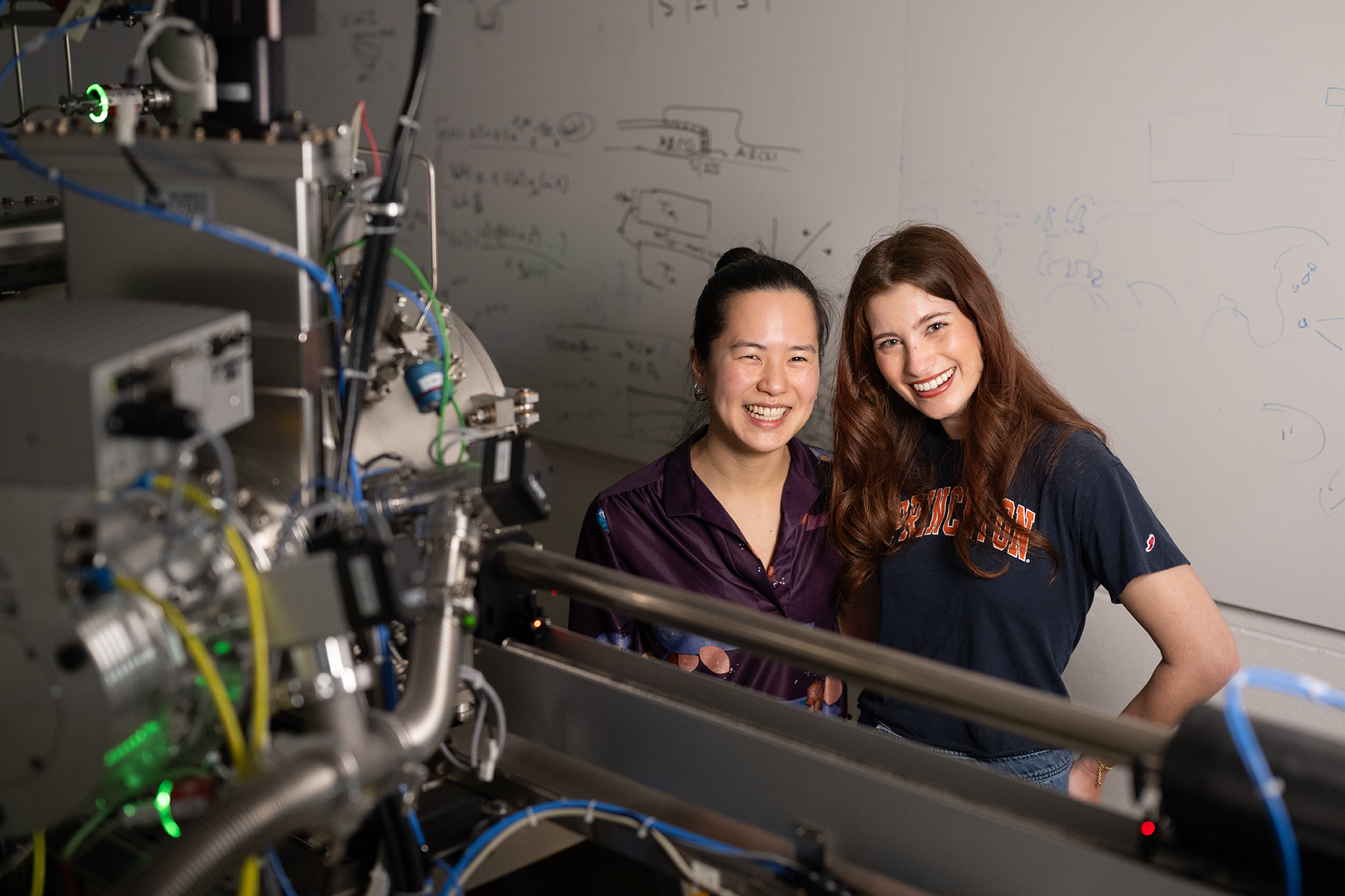
You can stand up for Princeton’s distinctive commitment to teaching, learning and research excellence by participating in this year’s Annual Giving campaign, which concludes June 30. To learn more about making a gift to broadly support Princeton’s research excellence, please contact the Office of Advancement at 609-258-6160. Your gift makes a real difference during this time of funding uncertainty.
The Endless Frontier documentary
Princeton Professor of Ecology and Evolutionary Biology Andrea Graham is featured in a new documentary film, The Endless Frontier, an urgent portrait of three scientists working to solve some of the most pressing challenges of our time. The film also explores the growing threat to the American research engine and what is at stake if it falters. To learn more about attending or hosting a screening, visit www.endlessfrontierfilm.com/screenings.
In the news
- Nature reported that the NSF has restricted the flow of new research grants to several universities, including Princeton. After The New York Times inquired about the slowdown, the administration began releasing some grant funding.
- The New York Times reports that more than 2,500 scientists said in a letter to Congress that the dismissal of the National Science Foundation’s oversight board could put the U.S. at a disadvantage with China. Related: New York Times reporting on the dismissal of the members of the NSF Board.
- President Eisgruber spoke to CBC about the value and future of universities.
- A recent Nature analysis shows that more than 100 independent advisory committees to science agencies were terminated in 2025, particularly at four agencies that fund scientific research: NSF, the Department of Energy, NASA and the Department of Health and Human Services.
- Princeton graduate alum Terence Tao *96 appears in this PBS News Hour story about top researchers who are considering leaving the U.S. amid federal funding cuts.
- The Conversation tackles the question of how much politics should influence science, and vice versa.
Share, forward and catch up
How are you standing up?
Share your success stories with us and we’ll feature them in future editions of this newsletter. Email us at standup@princeton.edu.
Share this update with friends
Share this newsletter with and encourage your friends to also Stand Up for Princeton and higher education!

Not subscribed yet?
Sign up for the Stand Up newsletter for ways to get involved plus stories, messaging and content you can share about Princeton’s positive impact on the world.