
Giving back to the places we call home

In the spirit of Thanksgiving, a time for giving back, we reflect on the important role that higher education institutions play in their home states and how alumni make a difference in communities across the country. This newsletter highlights Princeton programs that help people learn and thrive in New Jersey and the region — as well as alumni who are making a difference through service to their hometowns.
This holiday season, as you spend time with loved ones, perhaps in your hometowns, we hope you will spread the word about the impact of higher education and how it has inspired you to give back.
Share this video: Former Princeton football player launches nonprofit to revitalize his hometown
Justice Musser ’26 grew up in Damascus, Virginia, known for its Seven Trails, including the Creeper Trail, a scenic, 34-mile trail that draws thousands of locals and tourists alike each year. While Musser was attending Princeton, his hometown region endured devastating flooding caused by Hurricane Helene. Inspired by his love for the area, Musser launched The Ironwood Foundation with the goal of rebuilding the Creeper Trail and helping revitalize Appalachia. “Being part of the football team [at Princeton] has helped me create habits and discipline that I can then take on to the real world,” he says. Musser plans to attend law school and eventually move back to the Appalachian region to continue to serve his community.
For these Princeton SPIA alumni, public service begins at home

World capitals and global financial centers are not the only places where you’ll find alumni of Princeton’s School of Public and International Affairs. For some Princeton SPIA graduates, the best place to apply their skills is back home. Rachel Morrow MPA ’25 grew up in Northwest Arkansas and knew that she “wanted to return home and work on issues affecting communities across the state and the broader heartland.” While “going to Princeton was a chance to step back, build a stronger policy and leadership foundation and learn from people working on public problems all over the world,” Morrow says, “I never saw it as a departure from Arkansas.” Learn more about Morrow and others who are using their training to give back to their hometowns.
Mapping Princeton’s impact on a thriving regional ecosystem
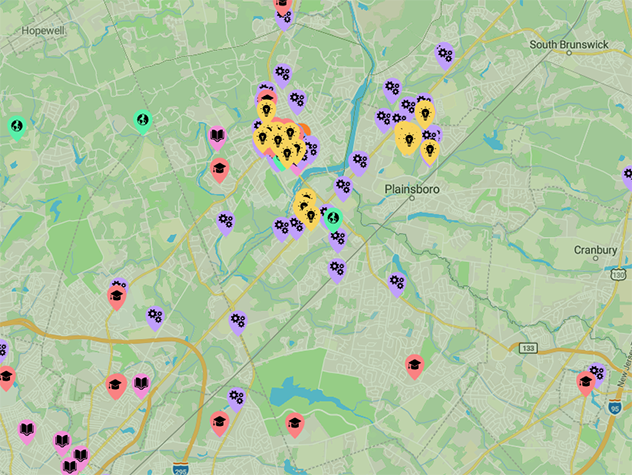
Princeton University is proud to be a driving force in cultivating a thriving regional ecosystem that strengthens education, civic and cultural resources and increases economic vitality in Central New Jersey. This interactive map features many of the ways Princeton University collaborates with local organizations and serves its surrounding communities. While not exhaustive, it highlights connections in the region surrounding campus and reflects how Princeton’s teaching, research, service, operations and partnerships contribute to the broader community and economy.
Applying lessons from the community to tackle real-world challenges
Through Princeton’s Program for Community-Engaged Scholarship (ProCES), faculty and students integrate community engagement into their academic liberal arts experience by partnering with area organizations and leaders to help advance community-identified priorities. Students in ProCES courses have conducted research on food security, tutored deaf children, designed apps for sustainable living, and performed water treatment analyses. Learn more about how ProCES connects the classroom with community experience.

Standing up for opportunity and college affordability

You can make a difference for Princeton students by supporting scholarships and fellowships. On the 25th anniversary of its transformative financial aid program, Princeton University announced the Talent Initiative, which aims to amplify the University’s historic commitment to financial aid and college affordability. The University’s first endowed scholarships were established before 1800, and alumni and friends have paid this commitment forward since the University’s beginning through additional endowed scholarships and fellowships and Annual Giving.
The initiative includes a fundraising focus on both undergraduate and graduate financial support. Princeton provides graduate fellowships for all degree-seeking Ph.D. candidates, and many master’s degree candidates for all years of regular program enrollment. Fellowships cover the full costs of tuition and fees and provide a stipend to support living expenses.
In the news
- One Princeton startup, PolyGone, is making New Jersey water cleaner. The company has launched the world’s first commercial scale microplastic filtration system at a wastewater treatment plant in Atlantic City. WHYY covered the launch last month. Graduate alumni Yidian Liu and Nathaniel Banks developed the system at Princeton with support from federal grants, Princeton’s Startup Bootcamp, and the NSF I-Corps Northeast Hub at Princeton. It is one way federal investment in higher education gives back to taxpayers and protects and improves the health of Americans.
- The Wall Street Journal discusses the expansiveness of financial aid at private universities and the circumstances driving a trend of private schools becoming cheaper than public ones for many students. Colleges in the Ivy League and beyond have been following in Princeton’s footsteps as the first college to provide all student aid in the form of grants, not loans, since 2001. This fall marks 25 years of the program, which has benefited 20,000 students.
- A new sweeping report from The New York Times details the impact of the federal administration’s multipronged approach to shrink the national research enterprise and undermine fundamental research at universities by withholding mass amounts of scientific funding.
- The Association of American Universities (AAU) published a piece about the implications of a newly Democratic-controlled Congress on science funding. With veto power in the executive branch and the power to undermine the scientific research enterprise through executive order, one AAU leader cautions not to expect an “immediate or dramatic shift in congressional support for science.”
Share, forward and catch up
How are you standing up?
Share your success stories with us and we’ll feature them in future editions of this newsletter. Email us at standup@princeton.edu.
Share this update with friends
Share this newsletter with and encourage your friends to also Stand Up for Princeton and higher education!
Not subscribed yet?
Sign up for the Stand Up newsletter for ways to get involved plus stories, messaging and content you can share about Princeton’s positive impact on the world.